This is a post about vibe coding. No, it is actually a post about the birth of my child! No, actually it’s a story about a technology brother deep into his current bout of AI psychosis, who manages to insert something something AI into everything in his life… (much better).
These caveats aside, I wanted to document here some ways I am using AI as a third brain when the first two brains (mine and my wife’s) are sleep deprived and performing at half capacity.
We welcomed our baby daughter (our first child!) a few months back. She was born healthy and sound, but as first-time parents we had a million things to be worried about despite the enormous support we received from the barselsklinik (maternity ward) nurses and doctors as well as the kommune nurse (I might write another post on the wonderful Danish medical system in the future!).
So naturally I resorted to the techbro approach of confiding everything to an AI. This had been in effect since the moment my wife got pregnant, with long, disparate chats with Gemini and ChatGPT over many months trying to figure out nutrition questions, disrupted sleep and a million other things. Around the 6th month, which was around the time Claude got a major upgrade across its product lines, I decided to go back to a Claude subscription after a year-long break. It was worth the jump since the projects and memory features in Claude were superior to Gemini’s Gems and ChatGPT’s Projects IMO. I spent a lot of time curating the memory and project context files so that I did not have to dump context for every new chat. I highly recommend this since this is the difference between an AI that gives suboptimal ungrounded answers and a hyper-personalized intelligent Jarvis!
All that support was still no relief for us new parents who had little idea of what to look out for. We went for a just-in-time (JIT) approach throughout the pregnancy where we used Claude, Gemini and ChatGPT to figure out the myriad doubts we had. To be clear about what that did and did not replace: none of it replaced the midwives, nurses or doctors. Mostly it helped us work out which questions were actually worth taking to them, and which ones we could stop worrying about at 2am. Once the baby was delivered, we were asked by the barselsklinik to keep track of the baby’s poops and wet diapers, and even the color of the poop =)
Since I could not sleep in the first few days and as I was into month two of my post-winter-2025 AI-agent psychosis, I started off with a mobile-friendly development approach. I already had a Claude project for everything pregnancy- and newborn-related, so there was enough context across the project memory and project markdown files. The first thing I did was explain the data I wanted to track and ask it to make a mockup using Artifacts (very nifty in JSX format, which you can download). After a few refinements, I asked it to write a spec.md document that I could hand over to Claude Code along with the JSX artifact. I already knew the tech stack I wanted: Supabase for auth/database, Vercel for hosting the webapp, plus GitHub Actions for automated builds from commits (this would prove very useful in my development scenario as you will shortly see).
The resulting spec.md and JSX artifact were then handed over to Claude Code on the Claude Android app (which was in turn connected to the empty GitHub repo I made earlier and had its own sandbox container managed by Anthropic). After a few messages back and forth in Plan mode, Claude went ahead and executed the project. The specs were quite straightforward so the execution took around 10–15 minutes, IIRC (though Claude, like most AI agents, estimated a (human) week of development time). I made sure in the specs to avoid anything that would push me beyond the free-tier limits of both Supabase and Vercel (which is why I dropped the photo storage feature).
GitHub Actions (again, Claude wrote the workflow file) meant that seconds after the first commit, Babytracker was live on Vercel. Super convenient!
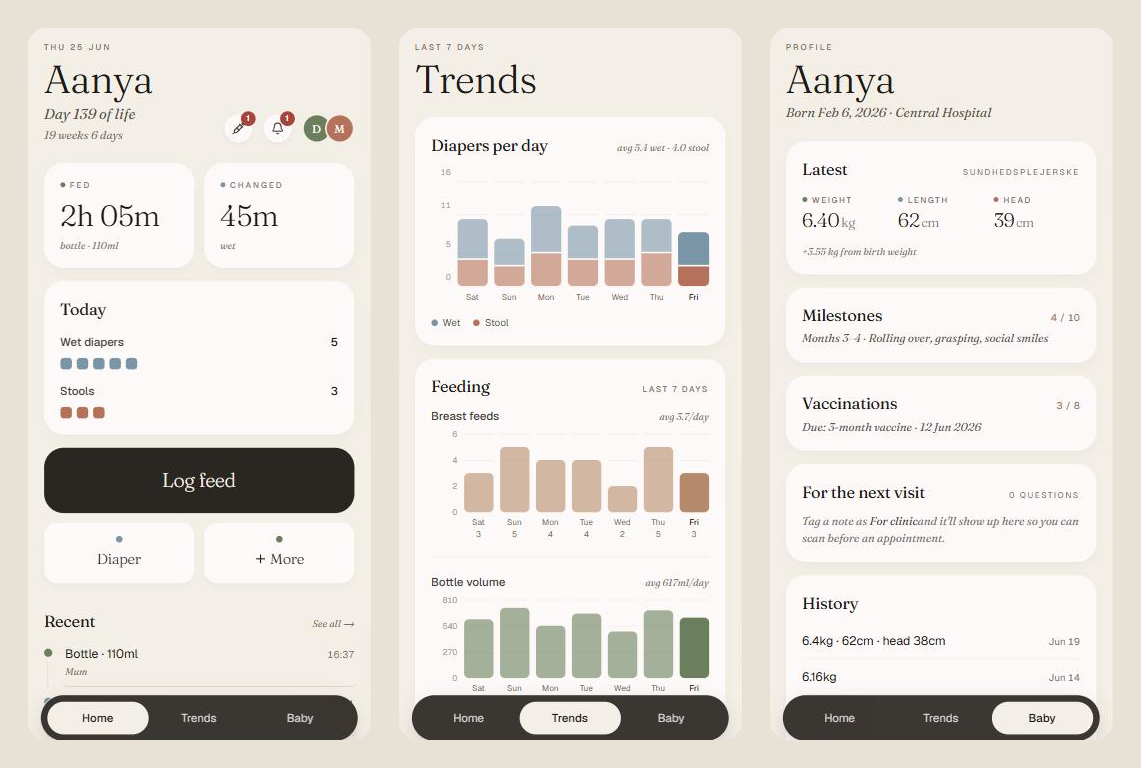
The three main screens. Every name, date and number above is simulated. The real thing is full of my daughter’s actual log, which is not going on the internet.
My wife ended up loving the app. Until then we had been tracking the time and quantity of breast milk, formula, diaper changes and so on in a shared Google Keep note. This turned out to matter more than I initially thought it would (I may or may not have jumped on the project as an excuse to play with Claude Code), since being a parent to a newborn means you are sleep-deprived and cognitively running on fumes, so an app to keep track of the mundane but necessary details proved genuinely useful!
What my wife did not expect was that I would behave exactly as any software engineer would, if left to their own devices, and push for feature creep. The next few big updates involved tracking milestones (you don’t need an app for this but it helps to have everything in one place) and diaper-bag restock alerts (surprisingly handy). Development and bug fixes are a breeze, since everything runs in the cloud, driven by chats in the Claude app. That cloud-first setup is a big part of why I stay on Claude Code Max (5x). Here is one of those sessions end to end — the tummy time chart, typed into the Claude app on my phone against a cloud checkout of the repo:
I keep expecting the part of this story where it all goes wrong: a hallucinated schema, a 3am data loss, a weekend spent undoing a bad refactor. It hasn’t come. I suspect that has less to do with the AI being flawless than with the specs being small and the stack being boring.
Another unexpected benefit was in being able to connect Claude to the app (specifically the Supabase database) via MCP. I already had a project with context (markdown files) and memory built up over a few months, so when asked a question, all Claude had to do was connect to the database via MCP, perform SQL queries and give an updated and contextualised answer. Context management/engineering is what transforms a mediocre experience with chatbots into something superhuman and super-convenient.
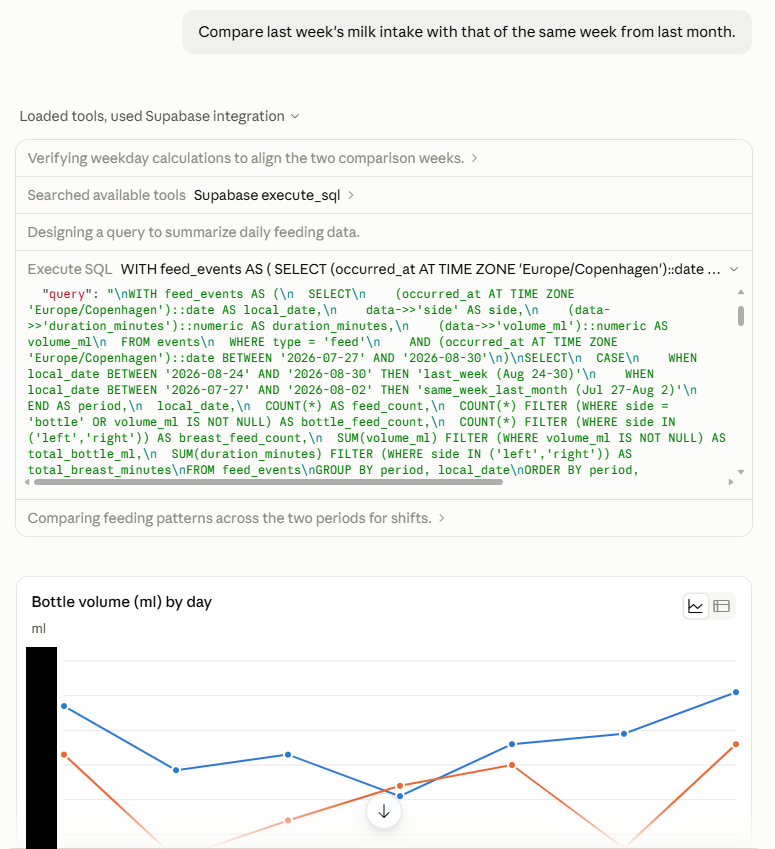
A question in plain English; Claude writes the SQL, runs it over MCP and plots the answer. The y-axis values are blanked out.
I am not sure where the app is going to go as the baby grows up, but I see the value in having hyper-personalized super apps for managing one’s life instead of trusting some random mobile app to offer security, privacy and relevant features. Geoff Litt calls this malleable software.
Finally, yes, I am aware that I spent the first half of this post handing my daughter’s data to three different AI companies. I don’t want to claim that I achieved complete privacy. It is that I know where the data sits, who can read it and what the app does with it, which is more than I could say for anything I would have installed from Play Store.